
Fish Ecology and Herbivory
The Fish Ecology component zeroed in on coral reef fish – especially parrotfish – and their role in reef resilience. Herbivorous fishes like parrotfish are often called “reef gardeners” because they eat algae that can otherwise overgrow and smother corals. The team, led by Dr. Richard Nemeth, investigated how environmental stressors (such as sediment runoff from land or coral bleaching events) alter parrotfish populations and their grazing behavior. They combined long-term fish survey data with new field experiments to answer questions like: Do reefs with more sediment have fewer parrotfish? Do parrotfish feed less on algae when sediments cover the reef? How do big disturbances, like the 2005 and 2010 coral bleaching events, impact the numbers and species of parrotfish over time? The ultimate goal was to understand what keeps the reef’s herbivore community healthy, since that is a key to coral recovery.
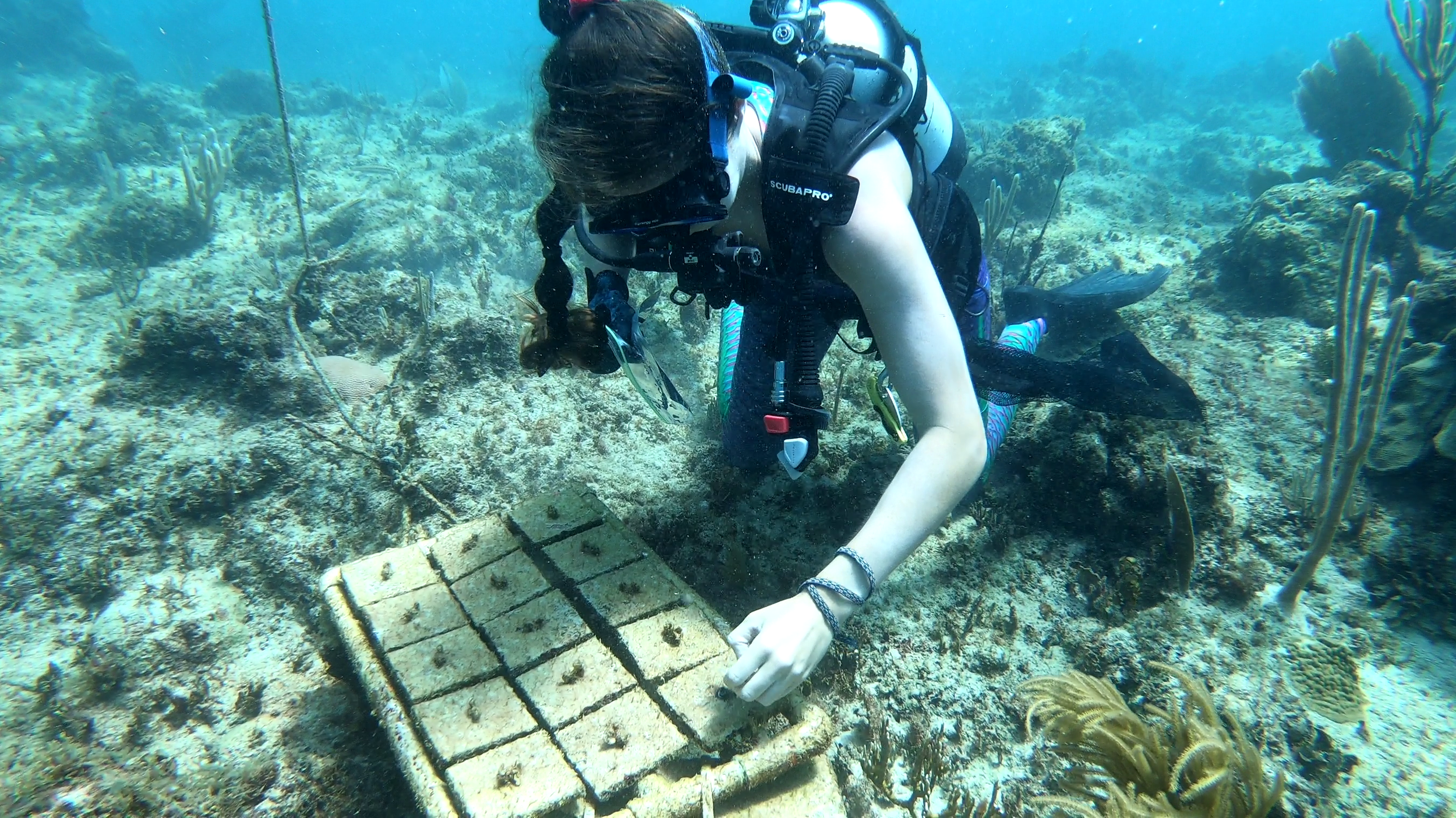
MMES student Jenna Cheramie removed a terracotta tile to measure the amount of sedimentation that has accumulated on the reef. Photo credit: R. Nemeth
Key Accomplishments
The team made significant findings by analyzing over 20 years of local reef monitoring data alongside measures of sedimentation. They confirmed that high levels of land-derived sediment on reefs correlate with changes in parrotfish communities. Specifically, on reefs near developed, runoff-prone watersheds, the biomass of Scarus parrotfishes (like blue and rainbow parrotfish) steadily declined as sediment levels increased. In contrast, Sparisoma parrotfishes (like redtail and stoplight parrotfish) showed a slight uptick at low sediment levels but then also dropped off when sediment became very high. This suggests that moderate sediment may favor certain scrapers initially (possibly by stimulating some algal growth that they eat), but excessive sediment is bad for all parrotfish. These findings were being prepared as a scientific manuscript.
To dig deeper, researchers conducted field studies on St. Thomas’s east end (clearer water, less sediment) versus west end (more sedimented reefs). They observed that at the sediment-heavy west sites, the reef had more fleshy brown seaweed and less turf algae compared to the clearer east sites. Importantly, yellowtail parrotfish feeding rates were much higher on the eastern, less sedimented reefs than on the western reefs. This indicated that sediment-laden algae is less palatable or accessible to the fish. In essence, when erosion from land dumps dirt onto a reef, it can indirectly reduce how effectively parrotfish graze, which in turn could slow coral recovery. Another line of investigation tracked where parrotfish go to spawn and whether sediment affects their reproduction. In Reef Bay, St. John, the team tagged spawning aggregations of a particular species and monitored them with acoustic receivers. They found that fish returned reliably to the same spawning sites, and initial data showed spawning activity was somewhat lower at the site nearer sediment-rich waters (western site) compared to the cleaner eastern site. Additionally, the project used novel ultrasound techniques on captured parrotfish to determine their sex and measure gonad development – contributing to understanding of how environmental conditions might influence fish fecundity.

Yellowtail parrotfish in Reef Bay, St. John, U. S. Virgin Islands is an ideal study species for examining the effects of sediment on feeding and reproduction. Photo: R. Nemeth
Innovation and Impacts: This project was notable for its interdisciplinary approach. It worked closely with the Watershed team to overlay land-runoff data with reef fish data, making the land-sea connection explicit. For example, sediment traps set by the watershed researchers helped quantify exactly how much sediment reached the reefs and allowed the fish team to correlate that with algal cover and fish behavior. The Fish Ecology team also employed cutting-edge tech, such as hydro-acoustic surveys and a Nortek Acoustic Doppler Current Profiler (ADCP), to understand the physical environment of fish spawning sites. In fact, they deployed underwater current meters at each spawning site to see how water flow might carry eggs and larvae, since connectivity between reefs is another piece of the resilience puzzle. All these efforts led to at least three scientific papers (with graduate students as lead authors) by 2023, and two citizen-science projects were spun off: one invited divers to report sightings of rare rainbow parrotfish via a smartphone app, logging over 70 sightings; another engaged students in measuring sediment on reefs using simple tools. In summary, the Fish Ecology research highlighted that protecting reefs from land-based sediment isn’t just about corals – it’s also about ensuring herbivorous fish can do their job keeping reefs clean. These insights have been shared with local fisheries and conservation agencies, reinforcing the need for integrated ridge-to-reef management.
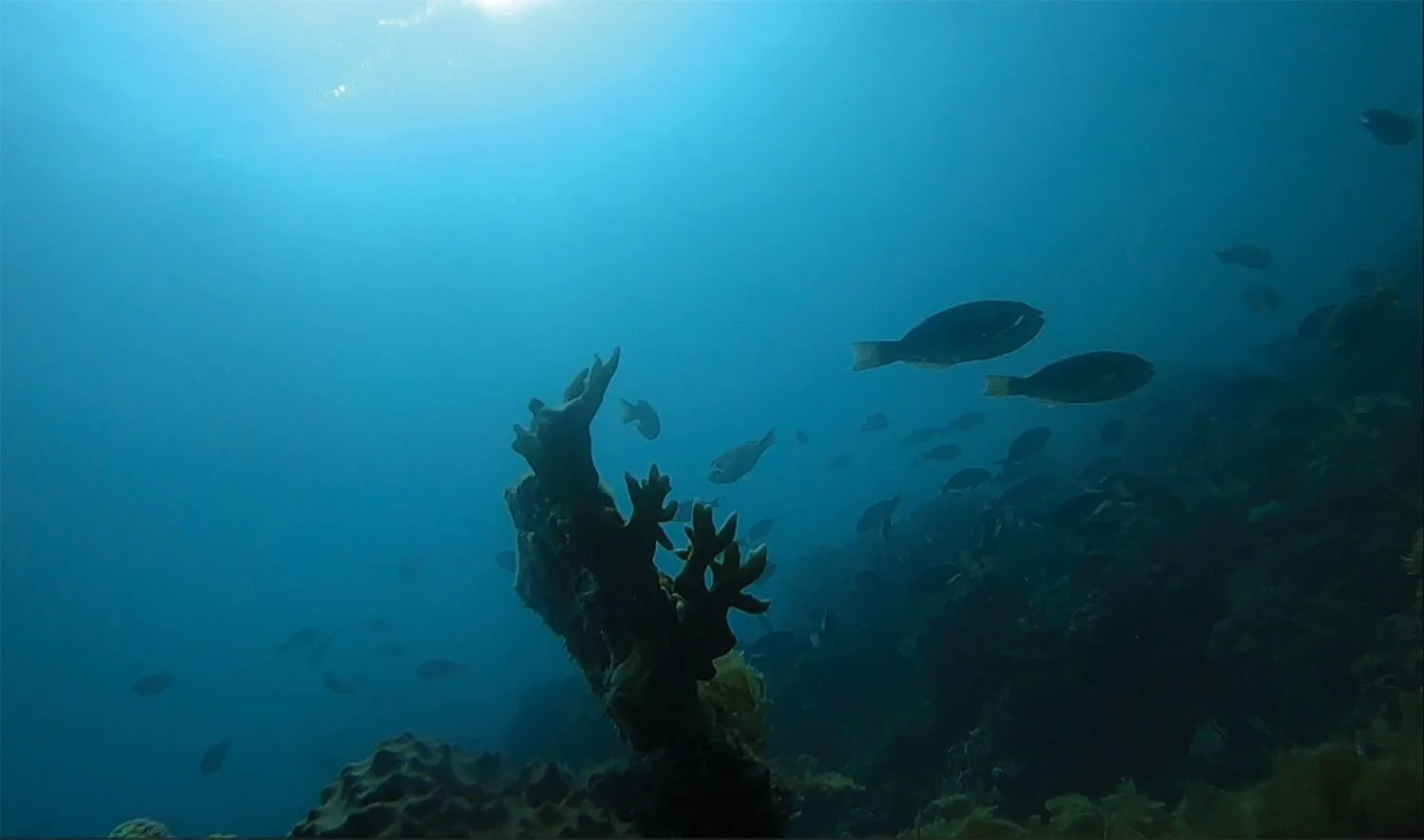
Yellowtail parrotfish at Coculus in St. John, USVI. Photo by R. Nemeth.

Dr. Richard Nemeth
Co-PI and Area Lead
Most of my research has focused on documenting the timing and location of reef fish spawning aggregations of commercially important species such as groupers, snapper and triggerfish. Using mark-recapture techniques and acoustic telemetry has helped to define boundaries of marine protected areas used to protect species from fishing during this critical period of reproduction. Movement ecology, using acoustic telemetry, has been applied to determine home range size and feeding habitats of a number of other species including tarpon, snappers, sting rays and sharks.
Understanding the environmental variables and ocean conditions, such as water temperature, current speed and direction, and how they influenced timing of spawning or other movement patterns is under investigation. Early work also examined the effects of land-based development on sedimentation rates and coral health. The current interdisciplinary research efforts will integrate previous research and provide a more comprehensive view of factors that contribute to coral reef resilience.