
Emerging Area: Seagrass Ecology
Shallow seagrass meadows are underwater pastures that protect shores and support marine life. This project’s emerging seagrass research focused on Halophila stipulacea, an invasive seagrass that has spread through USVI waters in recent years. Scientists wanted to understand how this newcomer might be affecting native seagrasses, beach stability, and marine food webs. Additionally, because healthy seagrass beds can buffer wave energy and reduce beach erosion, the team explored how different seagrass species influence water motion and sediment on our coasts. The work combined ecology with engineering: biologists and oceanographers teamed up to study everything from seagrass palatability (do local herbivores eat the invasive grass?) to seagrass effects on wave dynamics.

A seagrass meadow near the MacLean Marine Science Center, University of the Virgin Islands. Photo by D. Mele.
Key Accomplishments
The seagrass team, led by Dr. Edwin Cruz-Rivera, made several discoveries about Halophila. They conducted controlled feeding experiments offering the invasive grass vs. native seagrass to Caribbean herbivores (like sea urchins and fish) to test an “enemy release” hypothesis – the idea that an invasive might thrive if local grazers don’t eat it. Results showed that H. stipulacea was indeed less preferred by some herbivores compared to native seagrasses. This finding suggests the invasive could spread relatively unchecked, potentially outcompeting native plants. The team also looked at tiny invertebrates living in seagrass beds. By sampling seagrass plots at five sites (using gentle suction sampling for critters), they found that beds of the invasive grass hosted different invertebrate communities than native grass beds. This could have ripple effects up the food chain, as many juvenile fish rely on those invertebrates for food. On the physical side, researchers deployed instruments in Brewers Bay, St. Thomas to measure waves and currents through seagrass meadows. Early data indicated that taller, native seagrass species (like Thalassia) can dampen wave energy more effectively than the short, fern-like Halophila. Such insights are important for understanding shoreline erosion: if invasive seagrass replaces the native beds, coastlines might lose some natural wave protection.
By integrating these studies, the team painted a clearer picture of Halophila’s impact. They even examined the plant’s mechanical properties (how sturdy or flexible it is) and nutritional content, as these factors influence both its appeal to grazers and its ability to trap sediment. The seagrass researchers shared their findings widely, contributing to at least four peer-reviewed publications by Year 2. They also secured additional funding to expand the work – for example, one grant (from NASA) helped support genetic analysis of seagrass samples, to compare the DNA of invasive grass populations and possibly trace their source.
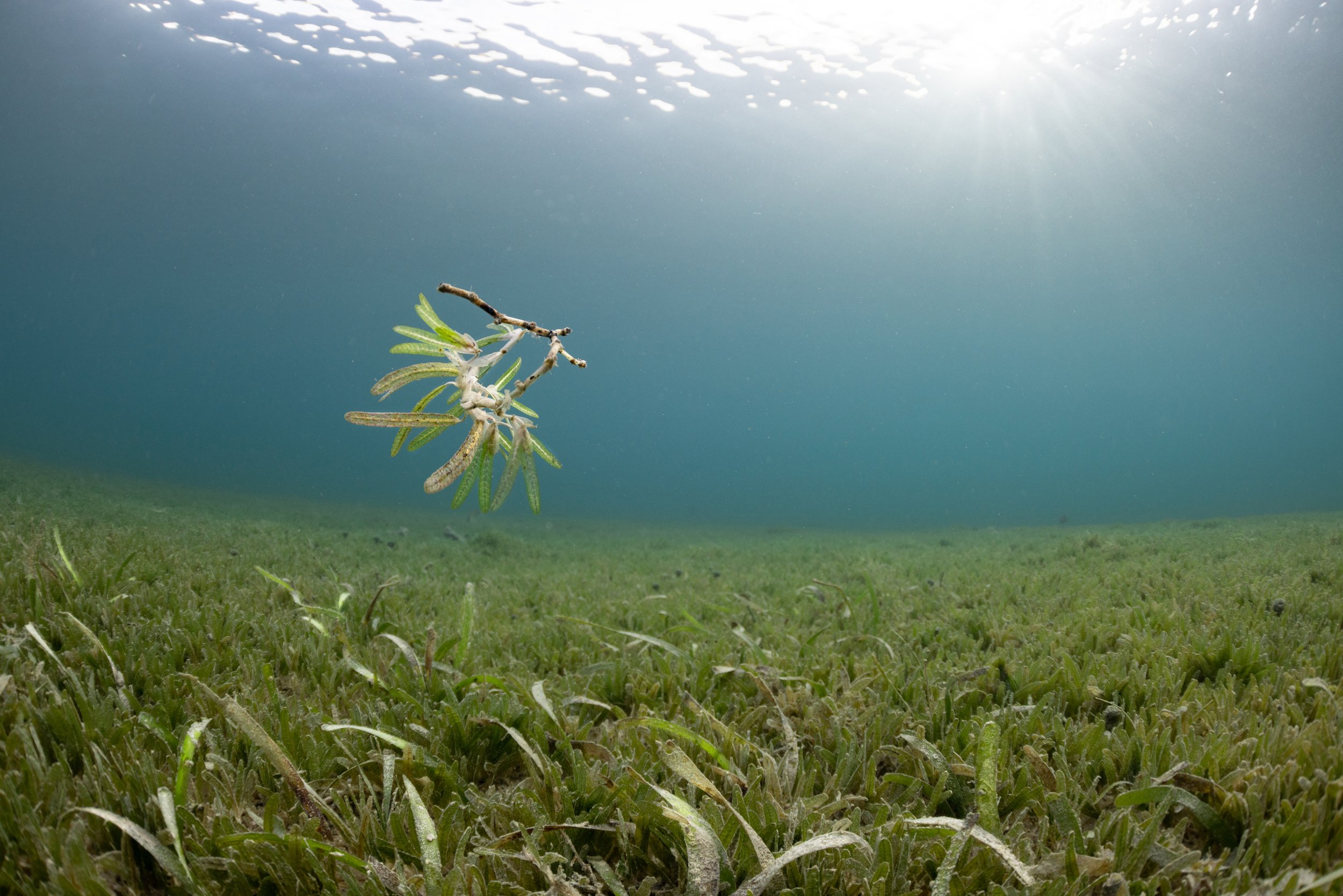
Halophila stipulacea floating in Brewers Bay, St .Thomas. Photo by D. Mele.
Impacts: This emerging research raised awareness about a new threat (invasive seagrass) and its ecological consequences. Resource managers in the V.I. are now better informed about H. stipulacea’s spread and the conditions it prefers. With this knowledge, there are discussions about monitoring the invasive in marine protected areas and even trialing removals in small plots to see if native seagrass can rebound. The work also highlighted the value of native seagrass for shoreline stability, reinforcing why protecting remaining native beds is important for coastal resilience. In terms of training, this project supported one graduate student and one undergraduate, who gained unique skills in marine fieldwork and data analysis. Their involvement aligns with the R2R goal to train the next generation of local marine scientists while addressing pressing environmental issues.

Sargassum washed up on a beach. Photo by D. Mele.

Project Lead: Dr. Edwin Cruz Rivera
I am an ecologist with broad interests and a fondness for invertebrates. My research interests have been largely focused on consumer-prey interactions, especially on the nutritional and chemical ecology of marine invertebrate herbivores and their algal, plant and cyanobacterial foods. My studies combine natural history observations and manipulative experiments in the lab and field to assess how consumer feeding and fitness are related. I have done research in a broad variety of environments, including the temperate North Atlantic and North Pacific coasts, the Chesapeake Bay, the Mediterranean Sea, both sides of the tropical Pacific, South Australia, the Red Sea, the Caribbean, brackish lakes in Egypt, temporary freshwater bodies in the Virgin Islands, and the South African intertidal. Therefore, I have been able to address fundamental ecological and environmental questions in tropical and temperate, marine and freshwater ecosystems.
Additional reading and links: