
This emerging research area addressed the changing shorelines of the Virgin Islands and the new challenges they face, from invasive seaweed inundations to climate-driven erosion. One focus was the phenomenon of Sargassum “golden tides.” Sargassum is a floating brown seaweed that in recent years washed up in massive quantities on Caribbean coastlines, including the USVI, affecting tourism, fisheries, and coastal ecosystems. The R2R team investigated why these influxes have grown so severe and what their impacts are on local waters. They collected and analyzed Sargassum samples to determine if genetic shifts in the algae might be causing blooms, and they monitored water quality where rotting Sargassum piles up, since decomposition can deplete oxygen and release nutrients. Another focus was more general: understanding long-term shoreline change and identifying which V.I. coastal areas are most vulnerable to hazards like storm surge and sea-level rise. To that end, coastal engineers and geographers in the project compiled extensive data on beach widths, sediment types, coastal development, and historic erosion rates for dozens of beaches and bays.

St. Croix, USVI. Stock photo.
Key Accomplishments
The project’s Sargassum research successfully pinpointed genetic markers to differentiate Sargassum strains, working with collaborators at University of Alabama-Birmingham. This helped determine that the Sargassum washing ashore in the USVI was part of the wider Caribbean bloom originating in the Atlantic’s so-called “Sargassum belt.” The team also developed methods to measure how Sargassum influxes affect coastal water conditions: for example, they set up sensors to record dissolved oxygen and pH in stagnant bay waters when Sargassum was decaying, as well as before-and-after sampling to detect nutrient spikes. Preliminary findings confirmed that large Sargassum strandings can create short-term “dead zones” in calm coves – areas of very low oxygen – which can stress fish and invertebrates. This information has been shared with local environmental authorities to guide beach clean-up responses (e.g. removing Sargassum piles promptly in enclosed bays to minimize water quality issues).
On the shoreline dynamics side, Dr. Greg Guannel and his team completed the first-ever comprehensive Coastal Vulnerability Index for the USVI. They surveyed and catalogued coastal features around all three main islands, noting where natural protections (like reefs or mangroves) exist and where human development is exposed. By combining data on wave exposure, storm surge modeling, historical shoreline retreat, and sea-level rise projections, they ranked sections of the shoreline by risk level. The result was delivered in 2023 as a detailed report to the V.I. Department of Planning and Natural Resources, providing a science-based roadmap for coastal planners. For example, the index highlights certain low-lying developed areas on St. Croix’s south shore as high-risk for flooding, suggesting where resilience measures (like seawalls or wetland restoration) might be priorities. Additionally, the team’s mapping of coastal land use trends revealed how beach ecosystems have been impacted by construction over decades, information that will feed into territorial land-use planning.
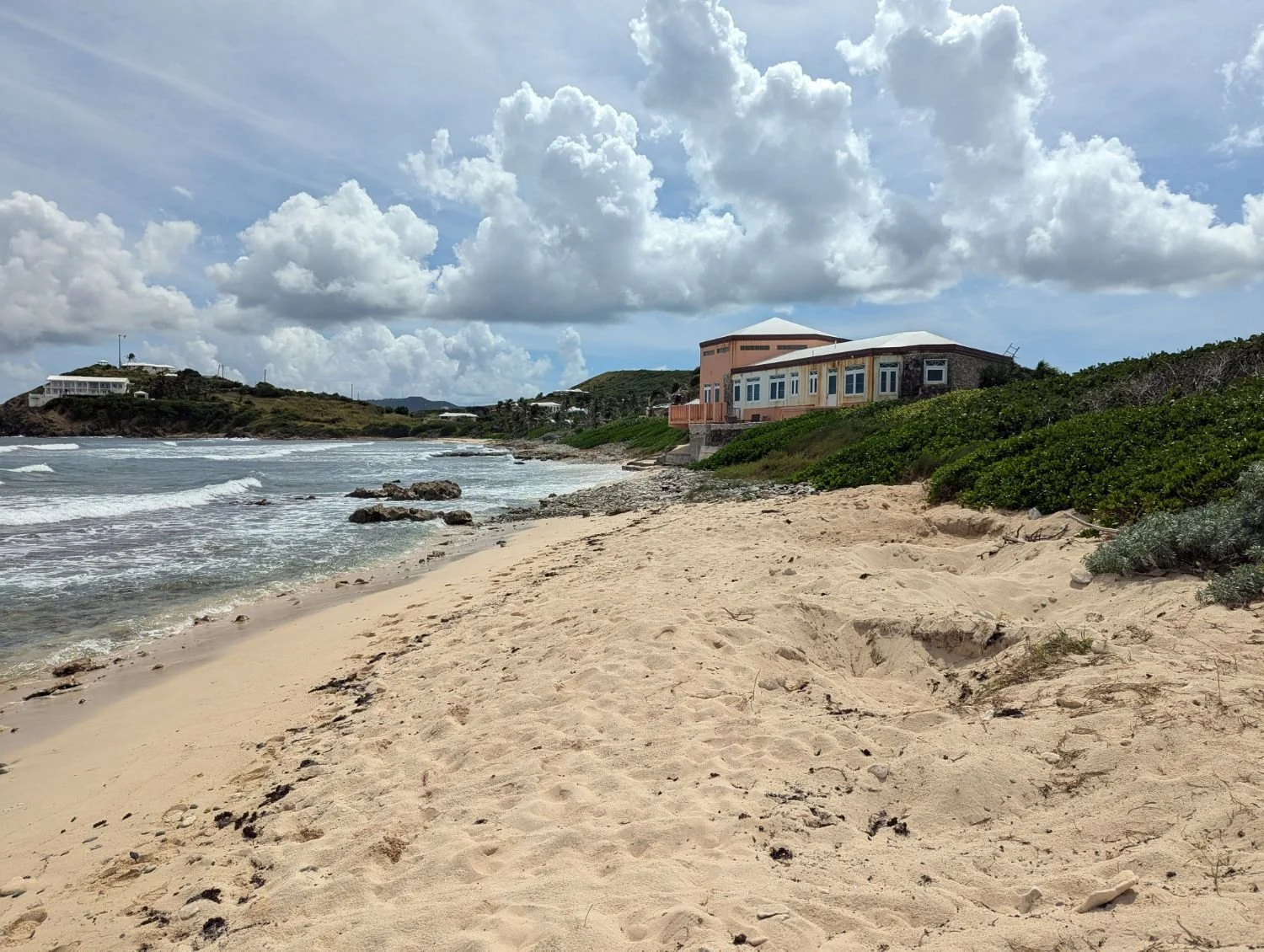
Judith’s Fancy, St. Croix. Photo by G. Guannel
Impacts: This emerging area yielded practical tools and knowledge for the territory. The Coastal Vulnerability Index is already informing discussions on climate adaptation – it gives the USVI a way to visualize where the next big hurricane or chronic sea-level rise could do the most damage, and thus where to focus mitigation efforts. As for Sargassum, the project raised public awareness about this new normal of periodic seaweed invasions. Team members participated in public webinars and produced educational materials explaining that Sargassum, while a natural occurrence, has reached unprecedented levels likely due to climate and nutrient changes. Understanding its origins and effects helps the tourism industry and communities prepare (for instance, hotels have improved their clean-up protocols to protect nearshore marine life). On St. Thomas, one community-led pilot project even used R2R’s findings to test a “seaweed boom” barrier to keep Sargassum from entering a sensitive bay, illustrating direct application of the science. Overall, the Shoreline Response effort met its strategic goals of investigating an emerging issue (Sargassum blooms) and providing decision-makers with cutting-edge analysis of coastal vulnerability. It strengthened links between scientists and agencies like Coastal Zone Management, paving the way for more science-guided coastal policy in the future.

Dr. Gregory Guannel
I'm a coastal engineer who has lots of experience modeling and quantifying how habitats interact and modify hydrodynamic processes.