
Teacher Professional Development, Mentoring & Research Infrastructure
This component of R2R focused on strengthening the STEM education pipeline in the Virgin Islands, from K-12 teachers to college faculty. The goals were to equip teachers with new skills and curricula (especially around the R2R environmental themes), to mentor and support students and early-career scientists, and to improve the territory’s educational infrastructure. In practice, that meant organizing teacher training institutes, building a network of mentors for undergraduate research, offering professional development workshops, and even helping develop new academic programs at UVI. The effort was led by the Education and Workforce Development team and the Virgin Islands Institute for STEM Education Research and Practice (VI-ISERP).

Mangrove in the USVI. Photo by Dan Mele.
Key Accomplishments
Despite challenges from the COVID-19 pandemic, the team launched a number of successful initiatives:
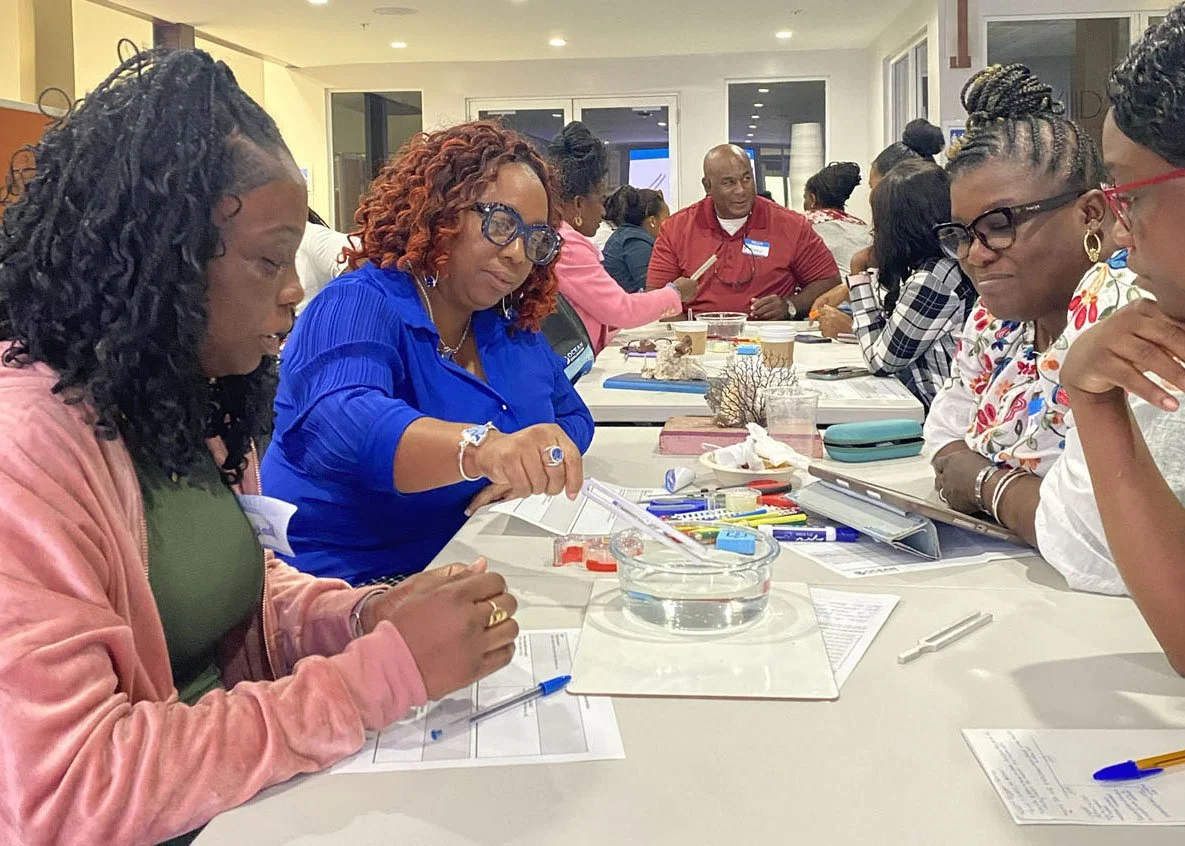
VI STEM Teacher Institute: In summer 2022, they hosted an intensive STEM teacher professional development institute that served 86 USVI teachers from public and private schools. Teachers received training in integrating technology and science concepts into their classes. For example, through a partnership with the Infosys Foundation and Georgia Tech, local teachers learned to use Micro:bit microcontrollers, Chibitronics circuits, and Finch Robots as hands-on tools in the classroom. They also had sessions on innovative pedagogy, like incorporating social-emotional learning and culturally relevant examples into STEM lessons. Over the course of the project, the Teacher PD program provided more than 4,000 teacher-hours of training – an impressive figure that reflects repeated workshops, follow-up “Teacher Talk Friday” sessions during the school year, and virtual courses on topics like math teaching strategies and using new software. Teachers responded enthusiastically, noting these opportunities were rare chances to refresh their skills and bring exciting content (like R2R research findings on mangroves or coral) back to their students.
Project-Based Learning (PBL) and Curriculum Integration: The team worked closely with a subset of teachers to develop project-based learning units tied to Ridge-to-Reef themes. For instance, two educators (one on St. Croix, one on St. Thomas) participated in a “practicum” where they built a PBL curriculum on marine debris and mangrove ecology, to be implemented in their schools. They were mentored through this process by VI-ISERP staff. Similarly, materials from the research teams – such as watershed data or coral photos – were turned into classroom resources. By the end of the project, a draft Mangrove Curriculum had been created and pilot-tested in a summer program, giving students a chance to learn science by doing (e.g., analyzing mangrove leaf litter or water salinity as part of a class project).
Mentoring & Research Infrastructure (MRI): This aspect supported both students and faculty. The UVI Voices of Women in STEM (VOWS) writing group was one standout. Held weekly across multiple semesters, VOWS provided a supportive space for female UVI graduate students and faculty to work on research writing and scholarship applications. Typically 8–10 participants joined each session, and by project’s end, several of these women had successfully submitted papers or theses, an outcome VOWS facilitated by accountability and peer feedback. The MRI team also ran at least 9 professional development workshops for UVI students and new researchers. These workshops covered practical career skills: how to write a strong résumé or CV, how to plan a research career, how to write abstracts for conferences, etc. The emphasis was on empowering local students to advance in STEM fields with confidence. Additionally, in partnership with UVI’s Title III program, the team helped design a new course (BIO/CHE 250: Professional Practice in Biomedical Science) as part of a Certificate in Biomedical Lab Science program. This course embedded workforce readiness and professional skills into the science curriculum, directly responding to workforce needs in the VI.
Early-Career Support: To encourage education research and innovation, VI-EPSCoR offered Educational Research Mini-Grants to UVI faculty. In Spring 2023, three junior STEM faculty received these grants to study teaching and learning on campus (for example, one project examined novel teaching methods in freshman science courses). This not only seeded local education research, but also helped tenure-track faculty build their portfolios. There was also mentorship training – a workshop specifically for research mentors to improve how they guide students, ensuring that as more undergraduates engaged in research, their mentors were prepared to support them effectively.

Impacts: Collectively, these efforts built a stronger foundation for STEM education in the territory. By training nearly 90 teachers and exposing them to R2R content, thousands of students will indirectly benefit as exciting science trickles into classrooms. Teachers now have new tools (like coding gadgets and environmental science projects) to inspire their students. The professional development for undergraduates likely contributed to increased participation in research; indeed, during the R2R project, multiple undergraduates took on research assistant roles in labs, something the mentoring infrastructure encouraged. We also see more support for traditionally underrepresented groups – women in STEM at UVI have a network (VOWS) and underrepresented minority students gained from targeted first-year experience enhancements. In fact, recognizing that incoming freshmen post-COVID needed extra help, the Undergraduate Education Research sub-team revamped the UVI first-year seminar courses (SCI 100 and SSC 100) to incorporate resilience themes and active learning, which was an adaptive response to keep those students in STEM. Early indications were that this helped engagement and retention for students who might otherwise struggle.
In terms of infrastructure, beyond the new academic offerings, intangible infrastructure like a culture of mentorship and collaboration has grown. Faculty across departments collaborated on the teacher institute and student workshops, forging lasting partnerships between UVI’s College of Science & Math and local schools. (Image suggestion: A photo of a lively teacher workshop with educators assembling small robots or sensors – showcasing local teachers enthusiastically learning new tech – would embody the spirit of the STEM Institute.) Finally, disseminating this work beyond the VI, team members gave presentations at national conferences (e.g., the National EPSCoR Education conference, NAAAS conference), highlighting the Virgin Islands as a leader in innovative STEM education in the context of environmental resilience. All these accomplishments align closely with R2R’s strategic goal of developing the human infrastructure needed for a more resilient, science-savvy Virgin Islands.

Joseph Squillace, Ph.D.
Teacher Professional Development Lead, St. Croix Campus
Dr. Squillace is an Assistant Professor of Mathematics at the University of the Virgin Islands, on the Albert A. Sheen campus. His research areas are combinatorics, mathematics teaching, and mathematics learning. Dr. Squillace has taught at the university level since 2012, and he is currently a co-director for the STEM Institute.
As a co-director for the STEM Institute, Dr. Squillace provides support to teachers by assisting them with their professional development, by presenting and sharing resources on technology in the mathematics classroom, and by incorporating project-based learning.
Dr. Squillace is interested in applying teaching methods that have proven to be successful, and he is always looking for new ways to stimulate the learning experience. In addition, he has created a Desmos directory that provides tutorials for teachers in high-school mathematics.

Michealrose Ravalier
Master Teacher
Ravalier is a Secondary Science Educator and Ph.D. Student at the University of the Virgin Islands. As an ardent believer in the Problem-based Approach to learning, she has leveraged her diverse background and creative thinking mindset to masterfully engage her students.
With a strong foundation in Microbiology and Environmental Science, holding both B.S. and MPH degrees from the University of South Florida, Michealrose Ravalier brings a wealth of expertise to her educational endeavors. Notably, she made history as the first Virgin Islander to be honored with the esteemed Maitland P. Simmons Memorial Award for New Teachers at the 2018 National Science Teaching Conference. Her distinction was further recognized when she earned the prestigious St. Thomas / St. John 2019/2020 District Teacher of the Year accolade. In 2021, she was honored with the Eco School Award from the Virgin Islands Department of Education.
Ms. Ravalier currently holds the position of Director of Professional Development for the St. Thomas St. John School District, where she extends her influence beyond her classroom. Her commitment to advancing education is further exemplified by her role as the Master Teacher with the VI EPSCOR, shaping the educational landscape of the St. Thomas district.

Verleen McSween Missole, Ph.D.
Mentoring and Research Infrastructure Lead
Verleen McSween PhD. is an Assistant Professor of Biology at the University of the Virgin Islands. She serves as the Director of the Mentoring and Research Infrastructure Component in the Virgin Islands Institute for STEM Education Research and Practice funded by NSF EPSCOR. Her current work focuses on characterization of institutional support structures that facilitate entry of STEM learners into the STEM workforce, and retention of STEM professionals in STEM career fields. She also serves as co- PI on an NIH funded training and workforce development grant, Undergraduate Research Training Initiative for Student Enhancement (U-RISE).
Additional reading and links:
Lorem ipsum dolor sit amet consectetur adipiscing elit. Quisque faucibus ex sapien vitae pellentesque sem placerat. In id cursus mi pretium tellus duis convallis. Tempus leo eu aenean sed diam urna tempor. Pulvinar vivamus fringilla lacus nec metus bibendum egestas. Iaculis massa nisl malesuada lacinia integer nunc posuere. Ut hendrerit semper vel class aptent taciti sociosqu. Ad litora torquent per conubia nostra inceptos himenaeos.
Lorem ipsum dolor sit amet consectetur adipiscing elit. Quisque faucibus ex sapien vitae pellentesque sem placerat. In id cursus mi pretium tellus duis convallis. Tempus leo eu aenean sed diam urna tempor. Pulvinar vivamus fringilla lacus nec metus bibendum egestas. Iaculis massa nisl malesuada lacinia integer nunc posuere. Ut hendrerit semper vel class aptent taciti sociosqu. Ad litora torquent per conubia nostra inceptos himenaeos.
Lorem ipsum dolor sit amet consectetur adipiscing elit. Quisque faucibus ex sapien vitae pellentesque sem placerat. In id cursus mi pretium tellus duis convallis. Tempus leo eu aenean sed diam urna tempor. Pulvinar vivamus fringilla lacus nec metus bibendum egestas. Iaculis massa nisl malesuada lacinia integer nunc posuere. Ut hendrerit semper vel class aptent taciti sociosqu. Ad litora torquent per conubia nostra inceptos himenaeos.
Lorem ipsum dolor sit amet consectetur adipiscing elit. Quisque faucibus ex sapien vitae pellentesque sem placerat. In id cursus mi pretium tellus duis convallis. Tempus leo eu aenean sed diam urna tempor. Pulvinar vivamus fringilla lacus nec metus bibendum egestas. Iaculis massa nisl malesuada lacinia integer nunc posuere. Ut hendrerit semper vel class aptent taciti sociosqu. Ad litora torquent per conubia nostra inceptos himenaeos.
Lorem ipsum dolor sit amet consectetur adipiscing elit. Quisque faucibus ex sapien vitae pellentesque sem placerat. In id cursus mi pretium tellus duis convallis. Tempus leo eu aenean sed diam urna tempor. Pulvinar vivamus fringilla lacus nec metus bibendum egestas. Iaculis massa nisl malesuada lacinia integer nunc posuere. Ut hendrerit semper vel class aptent taciti sociosqu. Ad litora torquent per conubia nostra inceptos himenaeos.