
Coral Disease & Restoration
This dual-focus team addressed both the dark side and the healing side of coral reefs: the spread of coral diseases that have recently devastated Caribbean reefs, and the restoration efforts to bring back corals in damaged areas. Disease, particularly the outbreak of Stony Coral Tissue Loss Disease (SCTLD) in the late 2010s, has killed large swaths of reef-building corals around the USVI. Dr. Marilyn Brandt’s disease research group examined how factors like water temperature, nutrients, and coral community composition influence disease dynamics. They aimed to predict where and when diseases would hit hardest, and whether having more diverse coral assemblages could slow disease spread (i.e., does biodiversity act as a buffer against epidemics?). Meanwhile, the restoration team (working closely with the Coral World-Ocean Park on St. Thomas and others) refined methods to grow corals in nurseries and outplant them to reefs. They investigated how outplant success is affected by things like species mix, genetic diversity, and water quality at the outplant site. Essentially, they were figuring out the best recipe to restore a coral reef in the USVI conditions.

Mangrove in the USVI. Photo by Dan Mele.
Key Accomplishments
On the disease front, the team carried out both lab experiments and field surveys. One controlled experiment tested the effect of thermal stress on coral disease transmission rates. By raising water temperatures on small coral colonies in the lab and introducing a pathogen, they found that warmer waters indeed accelerated disease spread – quantifying how climate change can worsen coral epidemics. This result was compiled in a master’s thesis in 2022. In the field, the team monitored multiple reef sites across St. Thomas and St. John, tracking disease incidence in relation to water quality measurements. They completed a comparative study of sites (seven sites in all) looking at Acropora coral health versus nutrient and turbidity levels in the water. The analysis, finished in 2023, suggested a correlation where corals in more turbid, nutrient-rich waters had higher disease occurrence – not a surprise, but solid local evidence that improving water quality could reduce disease vulnerability. Two graduate students combined their data on water quality and disease and presented a joint poster at the 2022 VI-EPSCoR conference, directly communicating these findings to the public and policymakers. Another noteworthy achievement was the development of a modeling framework that can simulate how a disease might spread across a reefscape given different inputs (like current patterns from the Oceanography model and maps of coral species distribution). This model is still being refined, but by inputting various scenarios, it can help predict, for example, if a disease outbreak starts at Reef X, which nearby reefs are most at risk and how quickly it could travel.
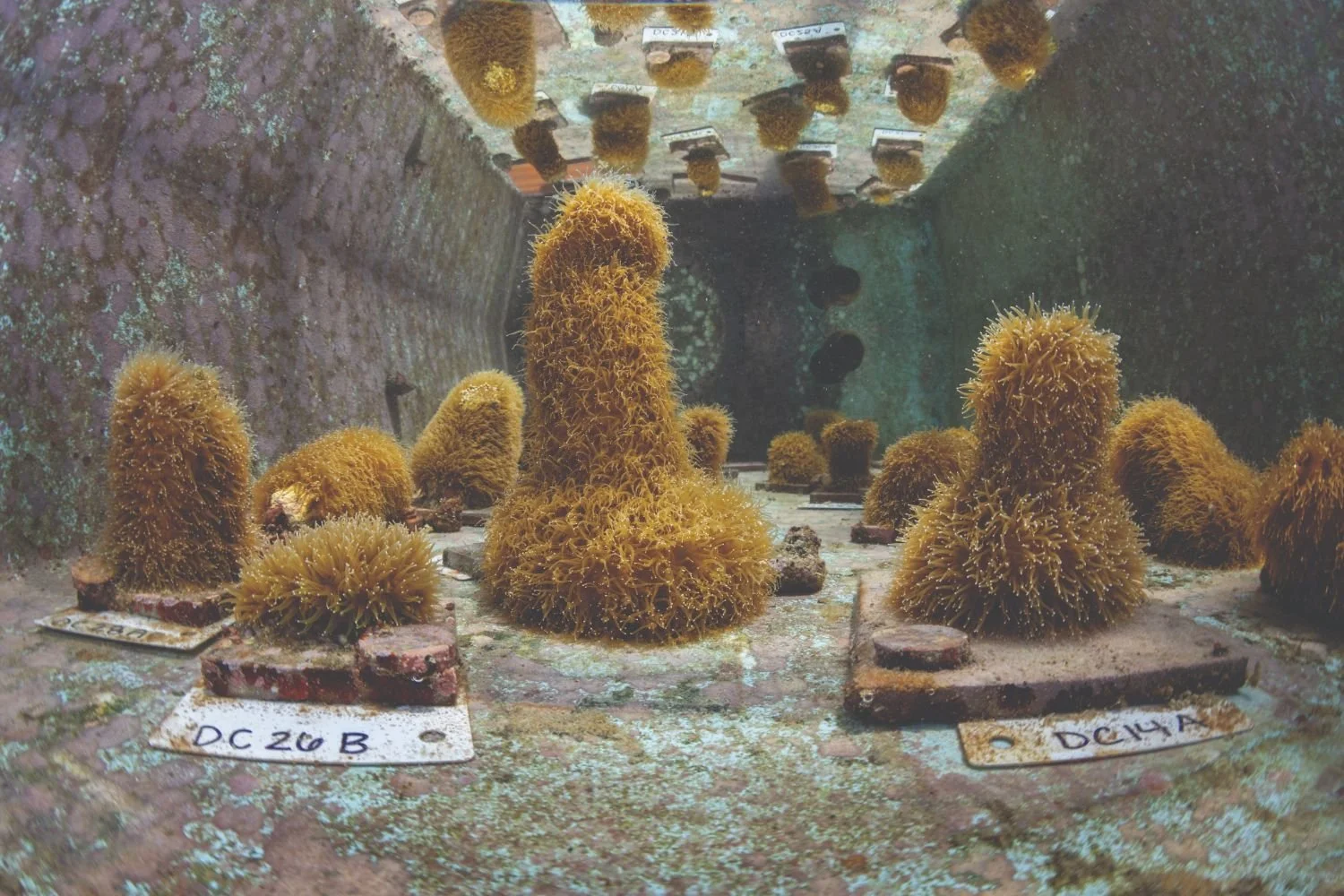
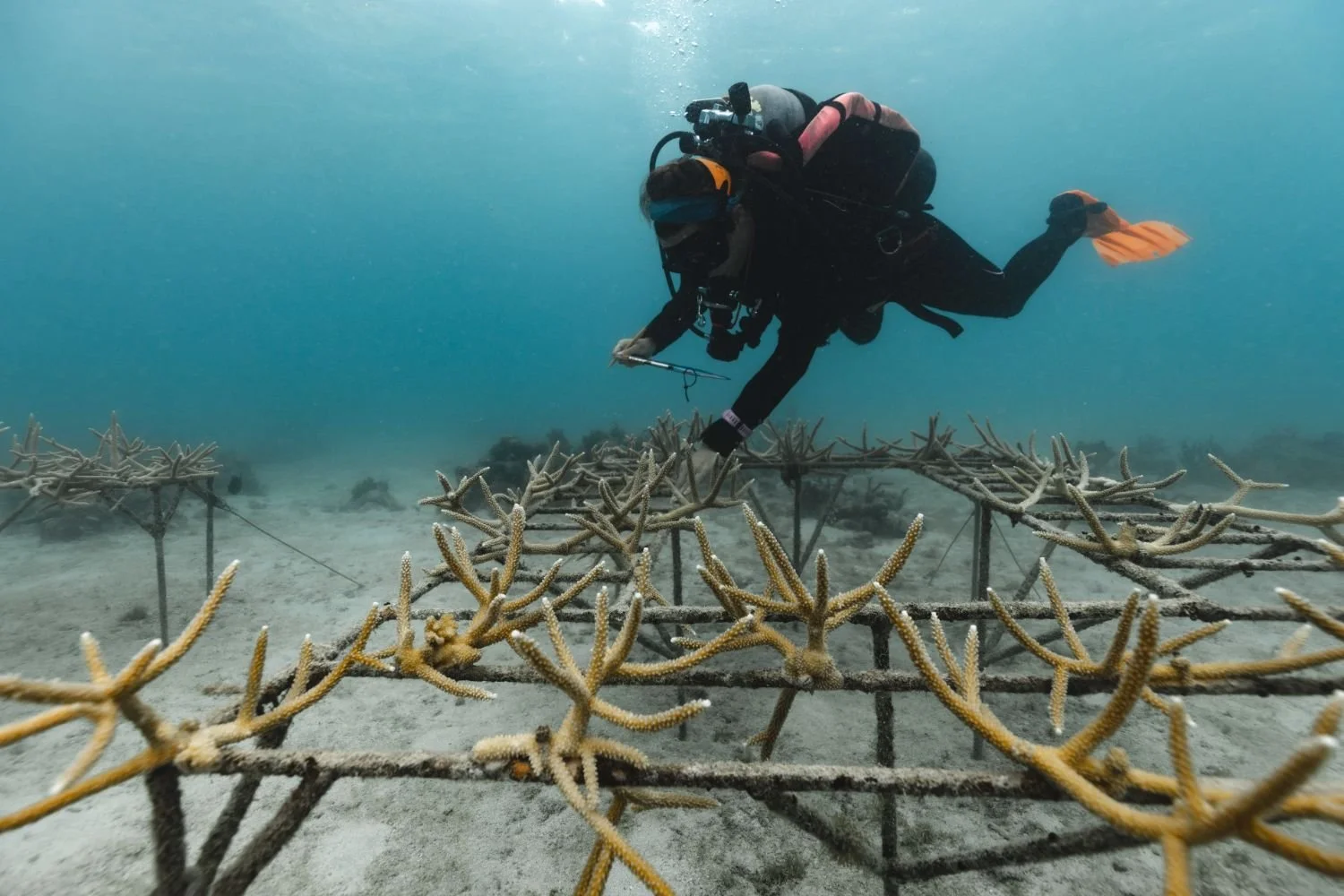
On the restoration side, the team made impressive strides in scaling up coral outplanting. They operated coral nurseries raising fragments of several species, including the endangered Acropora palmata (elkhorn coral) and Acropora cervicornis (staghorn coral). In early 2022 they launched a multi-species outplant experiment: corals were planted in clusters with different combinations – some plots with a single species/genotype, others mixing species and genotypes – to test if diversity improves restoration success. After over a year of monitoring, preliminary results showed that plots with mixed coral species had slightly higher survival and growth, hinting that diversity might confer resilience even in restoration settings. Additionally, they examined whether outplanting corals in turbid (cloudier) water would survive as well as those in clearer water. A master’s student, Adeline Shelby, led an experiment planting colonies of Orbicella annularis (a boulder coral) at a turbid inshore site and a clear offshore site for comparison. Data from this thesis is informing where future outplanting should concentrate (likely leaning toward clearer sites unless mitigation for turbidity is in place). Perhaps the most tangible impact: by 2025 the team and its partners had outplanted over 1,500 coral fragments to a designated “restoration reef” site off St. Thomas, achieving greater than 90% survival of those corals. This high success rate is encouraging and relatively high by global standards for reef restoration, showcasing the careful site selection and pre-nursery conditioning used in the project. The restoration crew also innovated with techniques like micro-fragmentation (growing tiny chips of corals that fuse into larger colonies faster) – for instance, micro-fragments of A. palmata grew and fully fused on special outplant cones, significantly speeding up the formation of larger coral patches on the reef.
Impacts: The Coral Disease & Restoration efforts had strong educational and community components. The team trained local “coral first responders” in disease identification and treatment (applying antibiotic paste to infected corals, a method that has helped save some colonies). They held demonstrations for dive shops and volunteers on how to spot diseases and what data to report, creating a network of citizen scientists monitoring reef health. On the restoration side, they worked with the private sector and NGOs – for example, Coral World and The Nature Conservancy – to expand nursery space and coordinate outplanting efforts territory-wide. The installation of informative signage at restoration sites (like Lovango Cay, where a sign now explains the ongoing coral planting project) helped publicize the work and its importance. Through VI-EPSCoR, several UVI students got involved in both lab and field aspects, from assisting with coral disease experiments to physically outplanting corals during internships. This hands-on experience is irreplaceable for building local expertise in reef management. (Image suggestion: A split-frame image with one side showing a coral with disease lesions (to illustrate the problem) and the other side showing divers outplanting healthy corals onto a reef (the solution), would capture this team’s dual focus.)
In summary, the Coral Disease research provided actionable insight that cooler, cleaner waters help keep corals healthy, reinforcing policies to curb coastal pollution and support marine protected areas. The Restoration research demonstrated that we can actively assist reef recovery, and it refined the techniques to do so effectively in USVI conditions – knowledge that will be applied in future large-scale restoration initiatives. Together, these efforts addressed strategic goals of understanding drivers of coral decline and developing science-based interventions to enhance reef resilience.

Dr. Marilyn Brandt
Marilyn Brandt is a Research Professor of Marine and Environmental Science at the University of the Virgin Islands (UVI). She fell in love with the Caribbean in college when she visited a childhood friend and pen pal in Trinidad. She went on to study Caribbean coral disease ecology while earning a bachelor’s degree in biology from New York University and then her Ph.D. in marine biology and fisheries from the University of Miami. She moved to St. Thomas to join the research faculty in the Center for Marine and Environmental Studies at UVI in 2010. Her research focuses on understanding how disease is damaging coral reefs and how coral conservation and restoration can reverse that damage. She is the Research Team Lead and an Executive Team member for the U.S. Virgin Islands Coral Disease Advisory Committee and she directs Reef Response, a coral restoration program at UVI which is focused on science-based coral restoration in the northern U.S. Virgin Islands.
Additional reading and links:
Lorem ipsum dolor sit amet consectetur adipiscing elit. Quisque faucibus ex sapien vitae pellentesque sem placerat. In id cursus mi pretium tellus duis convallis. Tempus leo eu aenean sed diam urna tempor. Pulvinar vivamus fringilla lacus nec metus bibendum egestas. Iaculis massa nisl malesuada lacinia integer nunc posuere. Ut hendrerit semper vel class aptent taciti sociosqu. Ad litora torquent per conubia nostra inceptos himenaeos.
Lorem ipsum dolor sit amet consectetur adipiscing elit. Quisque faucibus ex sapien vitae pellentesque sem placerat. In id cursus mi pretium tellus duis convallis. Tempus leo eu aenean sed diam urna tempor. Pulvinar vivamus fringilla lacus nec metus bibendum egestas. Iaculis massa nisl malesuada lacinia integer nunc posuere. Ut hendrerit semper vel class aptent taciti sociosqu. Ad litora torquent per conubia nostra inceptos himenaeos.
Lorem ipsum dolor sit amet consectetur adipiscing elit. Quisque faucibus ex sapien vitae pellentesque sem placerat. In id cursus mi pretium tellus duis convallis. Tempus leo eu aenean sed diam urna tempor. Pulvinar vivamus fringilla lacus nec metus bibendum egestas. Iaculis massa nisl malesuada lacinia integer nunc posuere. Ut hendrerit semper vel class aptent taciti sociosqu. Ad litora torquent per conubia nostra inceptos himenaeos.
Lorem ipsum dolor sit amet consectetur adipiscing elit. Quisque faucibus ex sapien vitae pellentesque sem placerat. In id cursus mi pretium tellus duis convallis. Tempus leo eu aenean sed diam urna tempor. Pulvinar vivamus fringilla lacus nec metus bibendum egestas. Iaculis massa nisl malesuada lacinia integer nunc posuere. Ut hendrerit semper vel class aptent taciti sociosqu. Ad litora torquent per conubia nostra inceptos himenaeos.
Lorem ipsum dolor sit amet consectetur adipiscing elit. Quisque faucibus ex sapien vitae pellentesque sem placerat. In id cursus mi pretium tellus duis convallis. Tempus leo eu aenean sed diam urna tempor. Pulvinar vivamus fringilla lacus nec metus bibendum egestas. Iaculis massa nisl malesuada lacinia integer nunc posuere. Ut hendrerit semper vel class aptent taciti sociosqu. Ad litora torquent per conubia nostra inceptos himenaeos.